Final-year project ideas · 2026/27

Machine Learning × Games

Investigations in procedural generation, game-playing agents, automated evaluation and gameplay data. Starter for ten on project ideas; final projects are a discussion with your project supervisor. Make it your own.

Projects

Choose a technical problem to investigate. A game engine, a Gymnasium environment or a bespoke simulation can be appropriate; the choice should serve the investigation.

8 projects

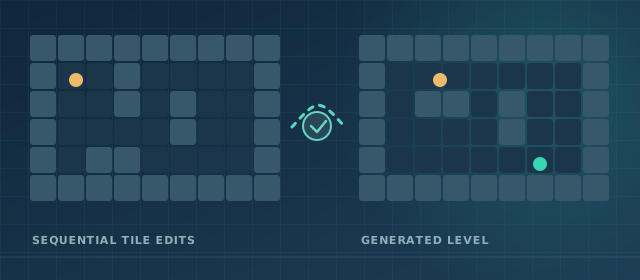
Two tiled 2D levels connected by a reinforcement-learning edit operation.
01Generation

AI-Driven Procedural Level Generation: Learning Level Design

Generative machine learning · PCG

A conventional generator follows rules a developer wrote by hand. Could a system instead learn to produce meaningful levels, by editing them step by step under a reward signal, or by learning from a corpus of examples? Investigate what such a system has actually learned, and what would count as evidence for that claim.

Read project brief
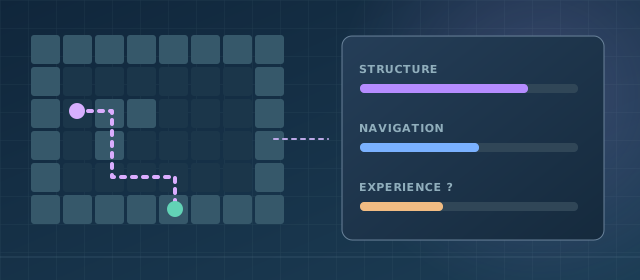
A tiled level alongside contrasting structural, navigation and experiential assessment indicators.
02Evaluation

Procedural Level Critic: Automated Evaluation of Generated Levels

Level analysis · Machine learning

Procedural generators can produce more content than a designer can inspect manually. Could a computational critic distinguish promising levels from problematic ones? Investigate what “quality” might mean in a particular game: formal properties, playability, challenge, visual composition or a player’s experience may not agree, and different qualities may demand different forms of evidence.

Read project brief
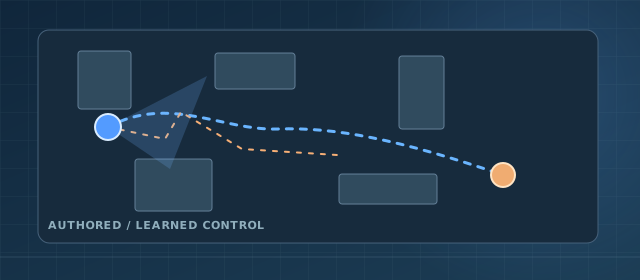
Top-down encounter showing an NPC, patrol trajectory and alternative pursuit route.
03Agents

Learning NPC Behaviour: Adaptive Game AI Beyond Authored Rules

Machine learning · Game AI

NPCs are often controlled by finite-state machines, behaviour trees and authored rules. What changes when an agent instead learns its responses, whether through reinforcement learning, imitation, or evolutionary search? Choose a pathway and a behavioural property that matters for your chosen role.

Read project brief
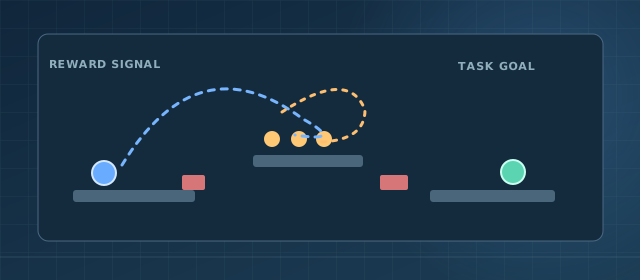
A platforming agent following a reward route that differs from the task goal.
04Agents

Reward Shaping in Reinforcement Learning

Reinforcement learning · Reward design

A reinforcement-learning agent only optimises the reward it is given, and how that reward is shaped changes what it ends up doing. Investigate how reward shaping affects training in a game of your choosing, comparing what a given reward formulation produces against what it was meant to achieve.

Read project brief
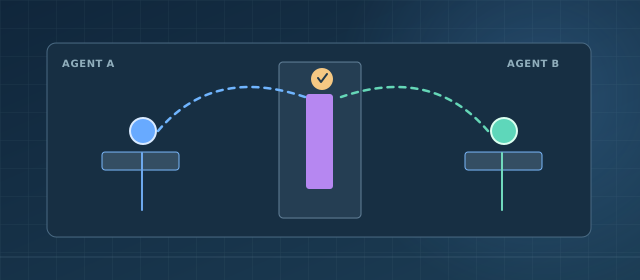
Two cooperating agents operating switches on opposite sides of a locked door.
05Agents

Cooperative Multi-Agent Reinforcement Learning in Games

Multi-agent reinforcement learning

Two agents may need to coordinate even when neither can complete a task alone. Do independent learners, each updating only from their own experience, converge on real cooperation, or does that only reliably happen with a jointly-trained approach? Investigate the difference in a compact multiplayer-style simulation.

Read project brief
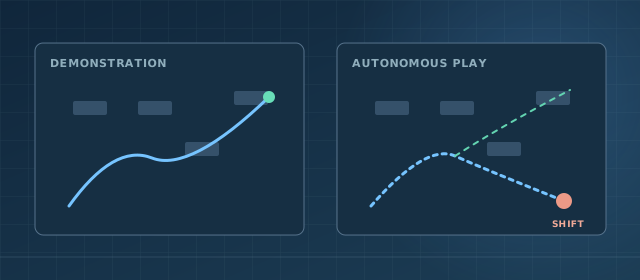
Demonstrated gameplay trajectory compared with a diverging autonomous trajectory.
06Agents

Imitation Learning from Gameplay Demonstrations

Imitation learning · Supervised ML

Choose a game where actions can be captured, collect demonstrations, then take either direction: train an agent to play from them and test whether it generalises beyond the demonstrated situations, or use the demonstrations as an analytical resource for what they reveal about strategy and skill.

Read project brief
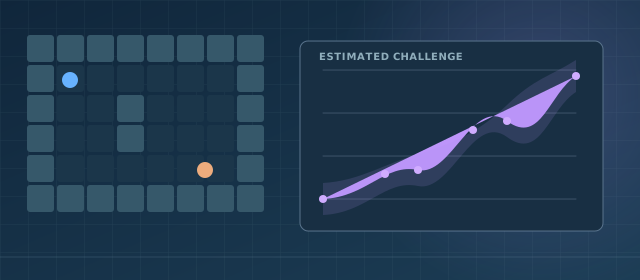
A tiled level beside a graph of estimated challenge and uncertainty.
07Evaluation

Predicting Difficulty in Procedurally Generated Game Levels

Supervised learning · PCG

A generator can produce many levels, but does it know how challenging they are? Investigate whether properties of a level can predict some defensible measure of difficulty. The hard part is defining what "difficulty" means for your chosen game and evidence; it depends on mechanics, player capability and what the chosen measurements actually represent.

Read project brief
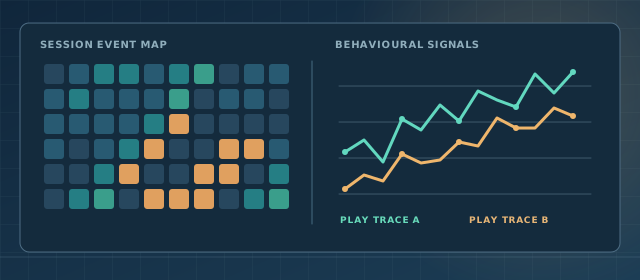
A game-session activity heatmap beside two player-behaviour time series.
08Analytics

Game Telemetry and Player Modelling

Machine learning · Data science

Game telemetry records movement, actions, decisions and failures, creating an opportunity to investigate patterns of play. Build a collection or analysis pipeline and explore whether behavioural features support useful predictions or reveal recurring strategies. The challenge is to distinguish what the data actually show from assumptions about players’ motives or stable “types”.

Read project brief