Game Telemetry and Player Modelling
Characterising and predicting behaviour from gameplay event data
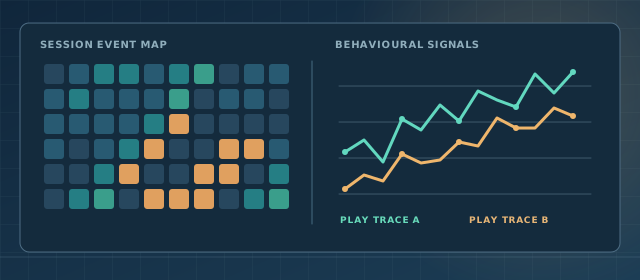
A game generates an event stream whenever a player moves, makes a decision, encounters an obstacle or completes an objective. Turning those events into insight requires decisions about sampling, representation, temporal context and what counts as a meaningful behavioural pattern. This project applies data science to a bounded gameplay problem rather than building a large analytics service.
What is player modelling?
Every player action can be logged as an event, a move, a menu choice, a death, building up a timestamped stream per session. Player modelling turns that stream into features (how often, how fast, in what order) and applies clustering or predictive models to find patterns: distinct strategies, early signals of later performance, or groups of similar players. The risk is over-interpreting a statistical pattern as a meaningful "player type".
Project concept
Instrument a game that interests you, or work with an appropriately documented existing dataset, and treat telemetry as something that could inform what happens next, not only produce a report after the fact. What that means is genuinely open: a tool that surfaces a player's strategy back to them, an offline replay analysis that identifies points where play deviated from an established pattern, or an idea of your own. Choose whichever raises the most interesting question for your data.
Questions to consider
These are possible directions for your investigation, not a ready-made research question.
- Can telemetry reveal a player's strategy while they are still playing, early enough that the information would be useful, not just in hindsight?
- Can a point where play deviated from an established pattern be identified after the fact, from recorded data, and what would that tell a player or designer that a summary statistic would not?
- If you pursue a live, in-play response instead, what would a defensible one look like, and what would count as evidence it actually helped rather than just changed behaviour?
- Which behaviours are visible in event logs, and which interpretations would require further evidence?
What might you produce?
Some usable telemetry capture or ingestion pipeline, a documented gameplay dataset, an analytical or predictive model, and an inspectable interface or visual report showing findings and uncertainty. The game or dataset is yours to choose.
Possible approach
An event schema and exploratory analysis is a sensible starting point. Define one modelling direction, investigate what features are available at the relevant time, and compare a simple analysis with a more involved model only when warranted.
Investigating the result
Separate exploratory description from prediction. Test predictive claims on suitably held-out sessions or players and guard against information from the future entering the input features. For exploratory clusters, investigate stability before inferring distinct player types.
Core concepts
- Game analytics and telemetry
- Player modelling
- Clustering or predictive modelling
- Event schemas and temporal features
- Generalisation and data leakage
- Interpretability
Indicative technologies
Choose tools that suit the research. An engine is not required if a simulation can answer the question.
- Python, pandas and scikit-learn
- CSV, JSON or SQLite event logs
- A small game in a student-chosen engine, or an existing dataset
- Matplotlib, Plotly or another visualisation library
Keeping the scope manageable
One game or one suitable dataset with a single analytical theme is enough to build on; the interpretive challenges of player data show up in a single session log just as much as in a live-service pipeline. Collecting identifiable player data may require ethics approval.
Explore the literature
Search the library using relevant terms such as:
- game telemetry and game analytics
- player modelling machine learning
- gameplay event logs
- behavioural feature engineering
- player behaviour clustering
- sequence modelling games
Papers and reading
- Drachen, A., Canossa, A. and Yannakakis, G. N. (2009) Player Modeling Using Self-Organization in Tomb Raider: Underworld. IEEE Symposium on Computational Intelligence and Games (CIG). IEEE Xplore.
- Trivedi, C., Makantasis, K., Liapis, A. and Yannakakis, G. N. (2022) Learning Task-Independent Game State Representations from Unlabeled Images. IEEE Conference on Games (CoG). IEEE Xplore (also arXiv).
Recommended reading:
- Yannakakis, G. N. and Togelius, J. (2018) Artificial Intelligence and Games. Springer.